
Who was Tiburcio Vasquez? He was a Californio from Monterey who led a robbery gang, served two terms at San Quentin, and went to the gallows for a man’s death during a store robbery. When Vásquez explained how he got there, he took a reporter back to a dance. The storekeeper remembered a neighbor who had only come in for a broom.
Both men left accounts. In a jailhouse interview, Vásquez explained why he believed he’d been driven to steal. A. Snyder remembered what it cost to be on the other end of that decision.
The dance floor in Monterey
Vásquez was born in 1835, when Monterey was part of Mexico. He went to school there and learned to read and write. His parents had a little land and enough to live on, he later said. He was twelve when Mexico ceded California to the United States in 1848. He could stay in his hometown and grow up in a different country.
The change reached well beyond the flag. Californio families who held land under Spanish or Mexican grants had to prove their claims to the new government. Even a family that won could lose land paying the lawyers. That was a real grievance. When Vásquez told his own story, though, the first insult he described was social.
At local dances around 1852, he said, American newcomers pushed the native-born men aside and took over the floor. He remembered getting into fights and coming to resent the officers who pursued him. He called what he felt “a spirit of hatred and revenge.” Those are the words that reached readers through the Los Angeles Star in 1874. A prisoner awaiting trial had good reason to want a reporter to hear his side.
What did he admit to taking?
One of the sharpest details in that interview is whom he robbed first. By his own account, he and his companions took money and clothes from traveling peddlers in Monterey County. Next came a stagecoach. He acknowledged leading the group from the beginning. He never explained what the peddlers had done to him.
A horse-theft conviction put Vásquez in San Quentin in 1857. Prison officials assigned him number 1217 and set him to work in the brickyard that supplied a new cell block. He left prison in 1863. In the interview, he said he’d tried to live quietly after his release until fresh accusations drove him away. He went back to stealing, served another prison term, and took up robbery again. In the summer of 1873 his gang turned up at a store where some of the men had once been paying customers.
The night at Snyder’s store
On August 26, 1873, Vásquez’s gang robbed Snyder’s general store at Tres Pinos, the settlement now called Paicines. Snyder recognized the men. His neighbor Lewis Smith, he recalled in an account preserved in a 1929 local history, had just stepped inside to buy a broom. Before long, Smith and the clerk were on the floor, and Snyder’s hands were tied.
Mrs. Snyder offered the robbers the household money if they’d spare her husband. Later, with his hands swelling, Snyder asked a third time for relief. He remembered Vásquez checking the ropes himself and loosening them. It eased the pain. The storekeeper also remembered exactly what he lost, down to his watch and two horses.
When the gang left, Smith’s boy freed his father, who untied the others. Snyder found his family safe. Next door, hotelkeeper Leander Davidson lay dead with his wife beside him. A shepherd, Bernard Bahury, and a wagon driver, George Redford, had also been killed. Redford had come to deliver fence pickets.
Snyder went out of his way to remember who eased the pressure on his wrists. How much credit would you give Vásquez for loosening a man’s ropes when he was also the one who tied them?
A prisoner sits for his picture
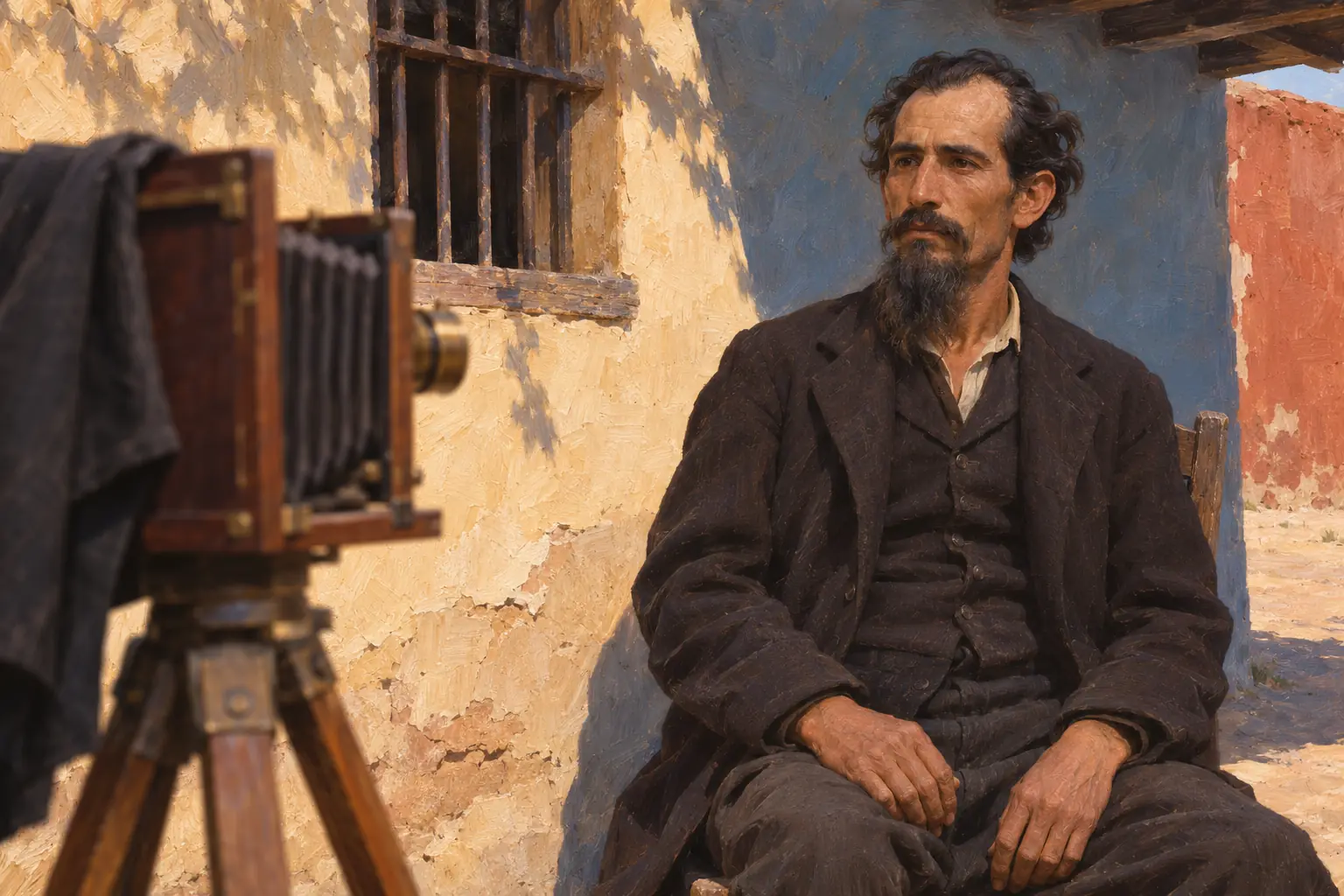
Officers captured Vásquez near Los Angeles in May 1874. While he waited in jail, a San Francisco photography firm offered him a quarter of the profits if he’d supply a negative. He agreed. On May 18, still sore from wounds suffered during his capture, he sat for photographer Valentin Wolfenstein in the shade behind the jail.
The deal went sour. Biographer John Boessenecker found that Wolfenstein kept the negatives and sold the prints himself. Customers paid twenty-five cents each. Vásquez saw none of it. A reader could now own the face that went with all those stories. Later, Vásquez signed photographs for visitors, giving them something the sheriff and the newspapers couldn’t supply.
John Wesley Hardin left a manuscript that his children published after his death. Vásquez got to make his case to readers while he was still alive. By the time a jury heard what had happened at Snyder’s store, the public had already met a remarkably polite man in print.
What the jury had to decide
Vásquez stood trial in San Jose in January 1875 for the murder of Leander Davidson. Abdón Leiva, who had taken part in the robbery, testified that Vásquez shot the hotelkeeper. Vásquez blamed another man. Both men had taken part, and each had reason to shift blame. Louis Schever, who had lived at the store, also identified Vásquez as Davidson’s killer. The judge explained why the jury could convict even if they had doubts about who fired.
Under California law at the time, a person who joined a robbery could be convicted of first-degree murder if an accomplice killed someone to carry out their shared plan. Even an order to spare lives would provide no defense under those circumstances. The jury convicted Vásquez. The California Supreme Court upheld the verdict.
Before his execution, Vásquez told reporter George Beers he understood why the law held him responsible for lives lost during his robberies. He still denied shooting Davidson. He was hanged in San Jose on March 19, 1875.
Why a Salinas school changed its name
For some Mexican Americans, Vásquez became a man who had spoken up about being pushed aside in his own home. Biographer John Boessenecker found plenty of working people among his victims and no evidence that he passed the proceeds to the poor. You can see how both histories stayed alive in one California neighborhood.
In 2012, school trustees in East Salinas voted to put his name on a new elementary school. Trustee José Castañeda saw someone who stood up for his people. Other residents objected to honoring a man convicted of murder. One member of the committee that later considered a change could picture Vásquez’s name on a social justice center and still opposed putting it on an elementary school. In 2016 the district renamed it Monte Bella Elementary.
If all you knew about Vásquez came from his interview, you might picture the young man pushed aside on the dance floor. Snyder gives you another picture to carry alongside it. When the robbers left, a boy got his father’s hands free. Lewis Smith had only come in for a broom.
Till next time, put that inner BadAss of yours to good use.

Explore our Old West Outlaws collection.
Sources and Further Reading
- University of Houston, Digital History — Resistance in California. Vásquez’s 1874 interview on the dances in Monterey, the peddlers he robbed and his years at San Quentin
- National Park Service — American Latino Theme Study. See the section on land grants for the cost of defending Mexican land titles after the war
- Don Chaddock, California Department of Corrections and Rehabilitation — San Quentin’s brickyard, the men killed at Tres Pinos and the capture near Los Angeles
- Library of Congress — Early Days at the Mission San Juan Bautista, chapter XI. Storekeeper A. Snyder recalls the raid, his family and the neighbors who helped one another (PDF)
- Robert Eliason, BenitoLink — Snyder’s General Store and the Downfall of Tiburcio Vasquez. Local history, witness testimony and the statement Vásquez gave George Beers
- California Supreme Court — People v. Vasquez, 49 Cal. 560 (1875). The jury instruction and the court’s ruling on the murder conviction
- Elias Serna, University of California, Riverside — Composing a Chican@ Rhetorical Tradition. See printed pages 115–121 on the photographs, autographs and Los Angeles Star interviews (PDF)
- Steve Harvey, Los Angeles Times — A Killer Created a Sensation in an L.A. Jail. The portrait sitting and what became of the promised share of the profits
- John Boessenecker, University of Oklahoma Press — Bandido: The Life and Times of Tiburcio Vasquez. A book-length study of his career and reputation
- Los Angeles Times — Old Guard, Young Blood Clash in Salinas’ Halls of Power. Local voices on the decision to name the school for Vásquez in 2012
- CBS San Francisco and Associated Press — The Alisal district’s 2016 vote to rename the school Monte Bella Elementary