
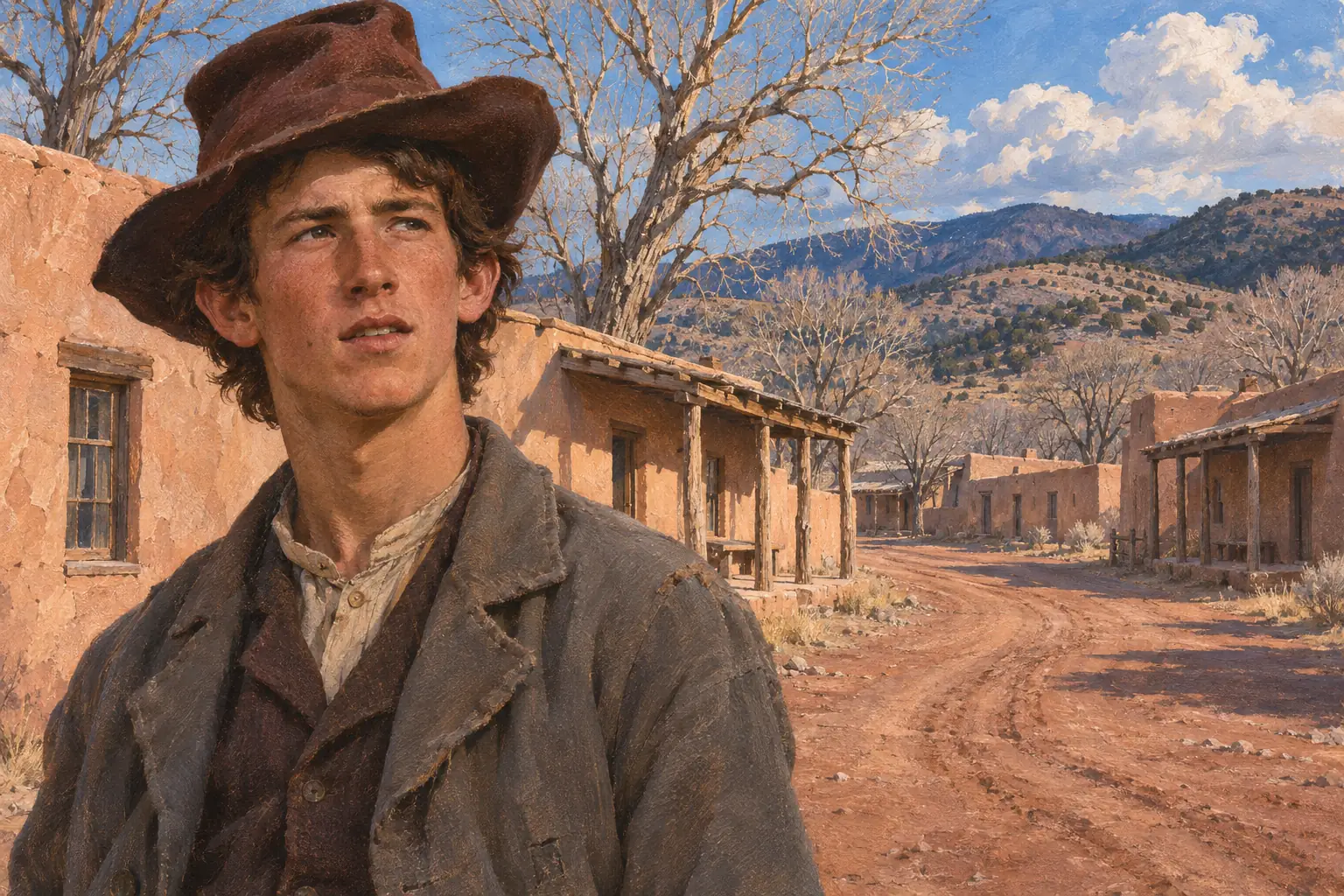
Why was Billy the Kid an outlaw? He was already on the run from a theft charge as a teenager. He killed a man in Arizona, then joined the men who killed a New Mexico sheriff after a posse shot his boss. A jury convicted him of the sheriff’s murder. In between the killing and the trial, though, the governor of New Mexico had a use for Billy on the other side of the courtroom.
He had seen a lawyer murdered in Lincoln. He could name the killers. What he wanted to know was whether he could take the witness stand and go home afterward.
The boy who signed his name Bonney
Before he signed letters W. H. Bonney, he was Henry McCarty. New York City around 1859 is a common account of his birth, though historians have yet to pin down the place or the date. His name turns up on firmer ground in Santa Fe in 1873. Henry and his brother Joseph were witnesses when their mother, Catherine, married William Antrim. That’s where another of Henry’s names, Kid Antrim, came from.
The family settled in Silver City, New Mexico Territory. Catherine died of tuberculosis in 1874. Henry went to live in a boardinghouse. A year later he landed in jail over clothes stolen from a Chinese laundry. Accounts differ on whether he helped with the theft or was caught with the goods. What the local paper could report by the end of that week was that the boy had escaped.
Henry found ranch work in Arizona. He also picked up a horse-theft charge. In August 1877 he got into a fight near Camp Grant with a blacksmith named Frank Cahill. Witness accounts describe Cahill getting the better of the smaller teenager. Henry shot him, and Cahill died the next day. That account helps explain why some historians see self-defense. Henry left Arizona before a trial could settle it.
How a ranch job drew him into the Lincoln County War
Back in New Mexico, Billy got caught with horses belonging to John Tunstall. The young English rancher did something unexpected. He hired Billy. Billy took the job and went to work with Tunstall’s cattle.
In Lincoln, merchants Lawrence Murphy and James Dolan had long held the upper hand. They sold goods on credit to local families and supplied beef under government contracts. Tunstall opened a rival store. A property dispute sent a posse acting for Sheriff William Brady after Tunstall’s livestock. On February 18, 1878, members of that posse killed Tunstall on the road to Lincoln.
Billy joined Tunstall’s foreman, Dick Brewer, and a group they called the Regulators. A local justice of the peace had authorized Brewer to make arrests. Then the territorial governor stripped the justice of his authority. Within weeks, men who had set out with the law behind them were wanted men themselves. Billy stayed with them.
On April 1, the Regulators killed Brady and his deputy George Hindman on Lincoln’s main street. Billy took part. Several men fired, and the evidence doesn’t tell us whose shot killed Brady. The charge that eventually brought Billy to trial was his part in that killing.
What did the governor offer him?
In Missouri, Jesse James had written to his governor to deny taking part in a murder. Billy had a different reason to write. In March 1879 he told Governor Lew Wallace that he had seen the killing of lawyer Huston Chapman. He said he feared his enemies would kill him if he gave himself up while charges from the Lincoln County War still hung over him.
Wallace answered in writing. He said he had the authority to spare Billy from prosecution if Billy testified. Put yourself in Billy’s place for a minute. Would you have taken the governor at his word and put yourself back in custody?
Billy did. He agreed to an arrest and testified before a grand jury in April. The local prosecutor pressed ahead with the charges against him. Historians still differ over exactly what Wallace promised in person. What happened on paper is clear enough. Billy never received a pardon. By December 1880 the same governor was offering $500 for his capture.
Two men who never went home
Sheriff Pat Garrett and his men captured Billy that December. In April 1881 a jury in Mesilla convicted him of murdering Brady, and the judge sentenced him to hang. Billy was taken back to Lincoln to await execution in the county courthouse. The building had once housed the Murphy and Dolan store.
On April 28, Billy escaped. He killed James Bell and Bob Olinger, the two men guarding him. News of his escape traveled across the country. Someone picking up a paper the next day could root for the young man who got away. In Lincoln, people had two men to bury. On July 14, 1881, Garrett shot and killed Billy at Fort Sumner.
Did Billy really kill twenty-one men?
You may have heard that Billy killed twenty-one men, one for every year of his life. Newspapers couldn’t even agree on a total at the time. The Library of Congress found accounts giving him credit for eleven deaths, nineteen, even thirty-six. In his 1926 book The Saga of Billy the Kid, Walter Noble Burns treated twenty-one as plausible. On the very same page he admitted he couldn’t name twenty-one people Billy had killed.
Garrett had beaten Burns into print by more than forty years. In 1882 a book appeared under Garrett’s name. The title promised The Authentic Life of Billy, the Kid. Garrett said he wanted to correct the stories already in print. His friend Ash Upson, a newspaperman, did the writing. A buyer could take home the sheriff’s side of the story with the word “authentic” right on the cover.
Billy left a little writing of his own. The Indiana Historical Society holds part of a letter to Wallace on fancy stationery with a figure of Liberty pressed into the paper. He signed that one “Billie.” In 1879 he was willing to walk into custody to give evidence. In 1881 he killed two men to walk out. That’s enough to reckon with in one short life.
Till next time, put that inner BadAss of yours to good use.

Explore our Old West Outlaws collection.
Sources and Further Reading
- PBS American Experience — The Life and Legend of Billy the Kid, a timeline
- Jon Tuska, Encyclopedia of the Great Plains — Billy the Kid’s early life and the Lincoln County War
- New Mexico Historic Sites — The rival stores and the old Lincoln County courthouse
- Pals of Billy the Kid Historical Society — Read Billy’s March 1879 letter and Governor Wallace’s reply
- PBS American Experience — The proposed pardon and the prosecutor’s decision
- Indiana Historical Society — The surviving page signed “Billie”
- New Mexico State Records Center and Archives — Guide to the indictments, death warrant and escape certificate
- Library of Congress — Young Gun, on newspaper death counts and Garrett’s 1882 book
- Walter Noble Burns — The Saga of Billy the Kid, page 61, on the claim of twenty-one killings