
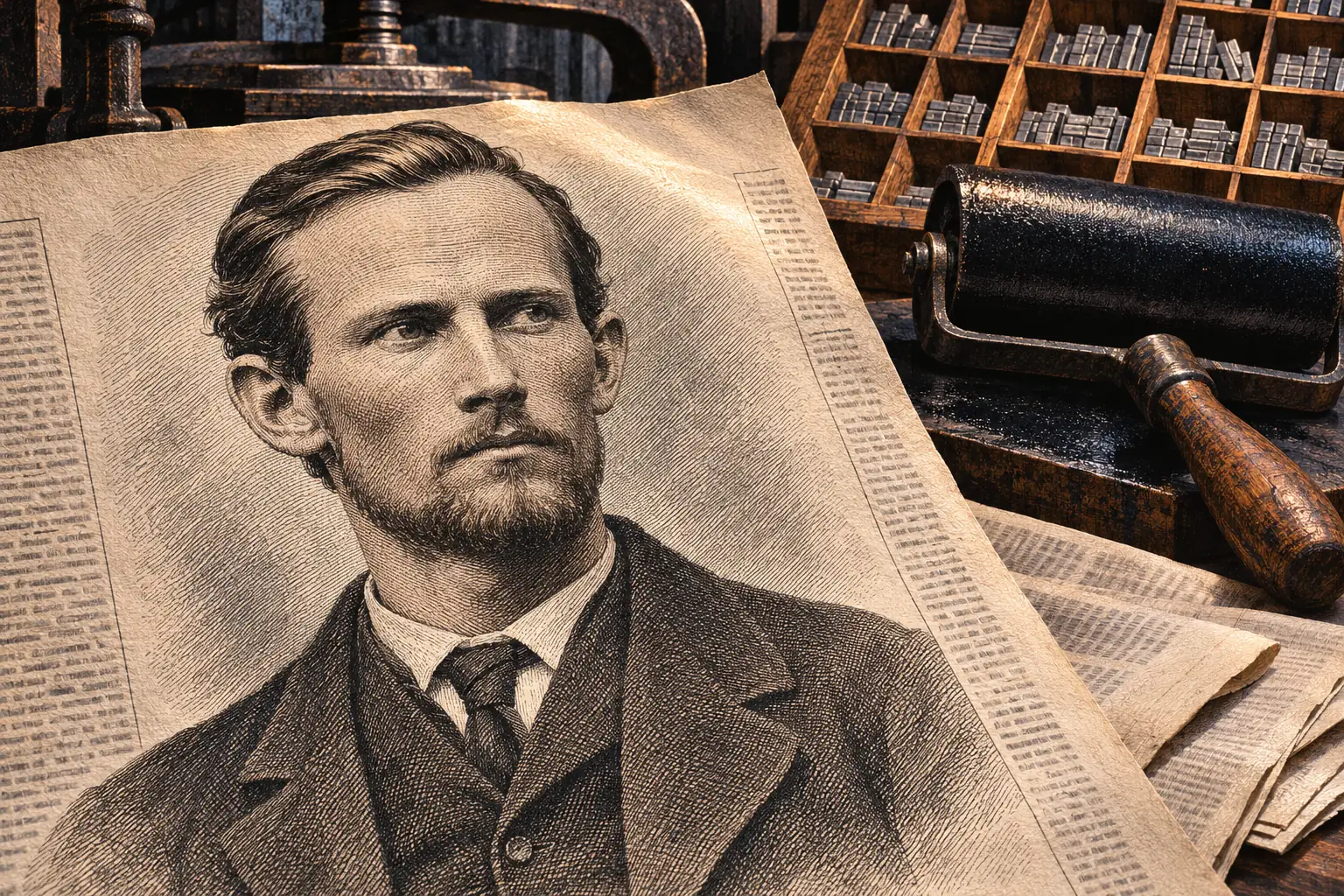
Why did Jesse James become an outlaw? At sixteen, he followed his older brother into a band of Confederate guerrillas. When the war ended, the brothers still had men they could ride with and neighbors willing to give them shelter. Jesse used those ties to rob banks and trains. Years later, when the old gang fell apart, he went out and put together another one.
Jesse also had something most bank robbers could only wish for. A Kansas City editor wanted readers to hear his side of the story. One of the first men who might have told it differently was a Missouri cashier named John Sheets.
Before he was an outlaw, he was Frank’s little brother
Jesse grew up in Clay County, Missouri. His father, Robert, was a Baptist preacher and farmer. Enslaved people grew hemp and tended sheep on the family farm. After Robert died, Jesse’s mother, Zerelda, raised her three children there. Of the six people she held in slavery, five were children themselves. Years before Jesse took a side in the Civil War, his family had a stake in what the war would decide.
Missouri stayed in the Union, but neighbors fought on opposite sides. Frank joined the Confederate side and eventually rode with guerrillas, known locally as bushwhackers. In 1863, Union troops came to the James farm looking for information about the guerrillas. They tortured Jesse’s stepfather, Reuben Samuel. He survived. For Jesse, the men hunting his brother had now hurt someone at his own home.
In 1864, Jesse rode with William “Bloody Bill” Anderson. That September he took part in Anderson’s raid on Centralia, Missouri, where the guerrillas killed unarmed Union soldiers they had taken off a train. Jesse later claimed he had killed a Union major in a battle outside town that afternoon. By the time the war ended, he had been both the boy whose family was attacked and one of the men other families had reason to fear.
What the war left behind in Missouri
Jesse was seventeen when the war ended. As he recovered from a chest wound, Missouri’s new government was shutting former Confederates out of the voting booth and public office. Many veterans went home to farm. Some of Frank and Jesse’s old comrades began robbing banks. Friends who sympathized with them could supply a meal, a fresh horse, or a place to sleep. Those favors went a long way for a man the sheriff was looking for.
It’s tempting to start Jesse’s criminal career with the 1866 bank robbery in Liberty, near his home. Former guerrillas were suspected, but the evidence placing Jesse there is thin. A robbery three years later gives us firmer ground. It also gives us a rare chance to hear what Jesse wanted the public to believe about him.
What happened to John Sheets in Gallatin?
On December 7, 1869, two men entered a bank in Gallatin, Missouri. John Sheets sat down to write a receipt. One of the men shot and killed him. Accounts of the killing linked it to Samuel P. Cox, the Union officer whose men had killed Bill Anderson. The State Historical Society of Missouri says Jesse mistook Sheets for Cox.
Sheets had served in the Union militia himself. He’d also been the county sheriff and recorded deeds for his neighbors. He’d worked at the bank since 1865. The James brothers never stood trial for his murder.
Jesse did take his case to the public. In June 1870, the Liberty Tribune printed a letter Jesse signed and addressed to Missouri’s governor. Jesse denied taking part. A horse left behind had been linked to him, he wrote, but he said he had already sold it. He also said he feared a mob would hang him before he could get a trial.
It was a shrewd letter. A reader could share Jesse’s fear of a lynching without knowing who had owned that horse on December 7. By the last line, the man whose life the reader had been asked to consider was Jesse. The man whose life someone had already taken was Sheets.
In 1879, Billy the Kid wrote to the governor of New Mexico with a different offer. He would testify about a murder he had witnessed if he could safely come into court.
How a newspaper editor helped sell the Robin Hood story
John Newman Edwards, a former Confederate officer and an editor at the Kansas City Times, wanted former Confederates back in power in Missouri. Edwards printed Jesse’s letters and praised the outlaws’ nerve. He offered his readers a rebel who stood up for Missouri farmers against powerful banks and railroads.
After a robbery at the Kansas City fair in 1872, the Times ran an editorial called “The Chivalry of Crime.” Chivalry was a word for knights. Here it was in the paper, attached to men who had taken the day’s receipts at a fair.
Jesse’s gang learned to supply its own copy, too. After a train robbery at Gads Hill, Missouri, in 1874, one of the robbers handed a crewman a written account for the press. It even had a blank space for the amount stolen. Apparently the story could go to print as soon as somebody finished counting.
Did Jesse share the money with poor families? Historians have found no reliable evidence that he did. At Gads Hill, passengers lost money and jewelry. The gang had left a much better paper trail for its publicity than for its supposed generosity.
In 1889, a publisher borrowed Jesse’s name to sell a book about Belle Starr. He billed her as “The Female Jesse James” and charged a quarter.
Who paid for the Northfield raid?
On September 7, 1876, the James-Younger gang rode into Northfield, Minnesota. At the First National Bank, acting cashier Joseph Lee Heywood refused to open the safe. He was a Union veteran and the father of a little girl named Lizzie. He served as treasurer for both Carleton College and the town. People had been trusting him with their money for years.
One of the robbers shot Heywood dead. Out on the street, Nicolaus Gustafson, a Swedish immigrant, was also shot. He died a few days later. The robbers got away with loose money from the bank. The deposits in the safe stayed in Northfield.
Jesse’s choice after the gang broke up
Frank and Jesse escaped to Tennessee and lived under other names. The Younger brothers were in prison. Back in Missouri, former Confederates had regained political power. Jesse still faced arrest, but he had managed to spend nearly three years out of public view. In 1879, he went back to Missouri and recruited a new gang, including young farmhands who had never ridden with him in the war. That October, the new gang robbed a train at Glendale, Missouri.
How much of that decision would you put down to the Civil War? It helps explain why a sixteen-year-old followed Frank. At Glendale, Jesse was thirty-two. This time the younger men were following him.
On April 3, 1882, Robert Ford, one of Jesse’s own men, shot him dead at his home in St. Joseph, Missouri.
There’s one detail worth adding to that Robin Hood story. After Heywood’s death, money really did reach a family in Northfield. Bankers around the country took up a collection for his widow and daughter. Lizzie went on to graduate from Carleton, the college that once trusted her father with its books.
Till next time, put that inner BadAss of yours to good use.

Explore our Old West Outlaws collection.
Sources and Further Reading
- State Historical Society of Missouri — Jesse James
- PBS American Experience — Jesse James — film and transcript
- Daviess County Historical Society — Who Was Murder Victim Capt. John Sheets and Why Was He Shot?
- PBS American Experience — Newspaper Accounts — Jesse’s 1870 letter and editorials from the time
- Daviess County Historical Society — Creating the James Legend — the editor and the Gads Hill press release
- Northfield History Center — 1876 Bank Raid
- Vanderbilt University — The Triumph of Common Decency — Joseph Lee Heywood and his family