
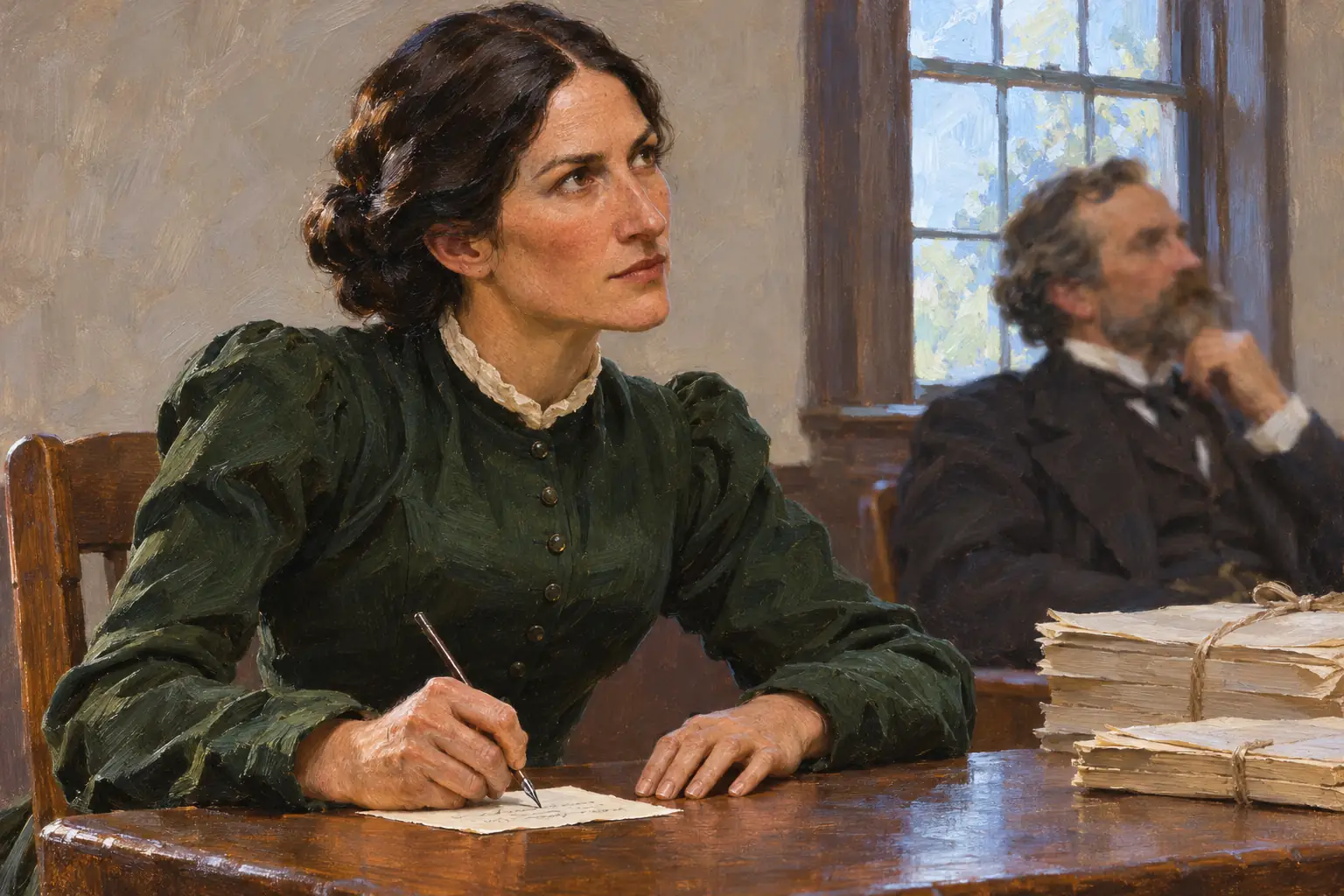
Who was Belle Starr? She was Myra Maybelle Shirley, a Missouri-born horsewoman who made her home in the Cherokee Nation and went to prison for stealing horses. After her murder in 1889, a New York publisher put her on the cover of a book, called her the Bandit Queen, and offered readers her life story for a quarter.
One of her neighbors might have priced that story differently. Andrew Crane wanted $85 for a missing bay horse. He knew the mark on its leg, he knew where Belle lived, and he went to her door to ask for it back.
The Missouri girl her family called May
Belle was born near Carthage, Missouri, on February 5, 1848. Her family called her May. Her father, John Shirley, ran an inn and held people in slavery. May went to school in Carthage and became a skilled rider. During the Civil War, her family supported the Confederacy. Her older brother Bud rode with Confederate guerrillas and was killed during the war.
By 1864 the Shirleys had moved to Scyene, Texas, near Dallas. Some of the people they had known in Missouri turned up again. The Texas State Historical Association names Cole Younger and Jesse James among the men who took shelter at the Shirley home. May was still a teenager. More than twenty years later, that connection to Jesse would turn up in big letters on a book cover.
What can we tie to Belle herself?
In 1866 she married Jim Reed, whom she’d known back in Missouri. They had two children, Rosie Lee, called Pearl, and James Edwin, called Ed. Reed took part in robbing a stagecoach in Texas in 1874. Belle was named as an accessory, an accusation that she had helped him. Historians have found no evidence that puts her at the robbery. A deputy killed Reed later that year.
Belle married Sam Starr, a Cherokee man, in 1880. They settled at Youngers’ Bend on the Canadian River, on land held in common by the Cherokee Nation in what is now Oklahoma. Fugitives found shelter at their cabin. By then Belle had a say in who came through the door.
On July 31, 1882, a federal court commissioner signed a warrant for both Starrs. You can read it today. It gives the alleged offense as larceny, or theft, and dates it to around April 20. The warrant doesn’t name a horse or an owner. For those details, you have to follow the case into court.
The neighbor who wanted his horse back
In his history of the Fort Smith court, Edwin C. Bearss recounts Crane’s effort to recover his horse. It was a big bay with a star on its forehead and a rope mark on its left foreleg. Crane told Belle he would take the horse itself or its value in cash.
In that account, Belle sent Crane to another neighbor, John West, for $30 and offered to make up the rest. West refused. Crane went back to the Starrs. He waited for Belle to send him money. It never came. Eventually he took his complaint to the authorities. Another owner, Sam Campbell, had lost a gray mare.
When the case reached Judge Isaac Parker’s courtroom in Fort Smith, Arkansas, spectators packed the room. Belle declined to testify. She spent part of the trial writing notes to her lawyers while they challenged the testimony against her.
The Oklahoma Historical Society’s short biography lists horse theft as Belle’s only documented crime. At the 1883 trial, the jury got more specific. It found both Starrs guilty of stealing Crane’s bay and Belle guilty of taking Campbell’s mare as well.
Belle arranged for friends and relatives to look after her children before she went to the Detroit House of Correction. She served about nine months. Three years later she faced another horse-theft charge. This time the jury acquitted her. Suppose you’d sat on that second jury. You already knew what happened to Crane’s horse. What would you have needed to hear about this one?
What happened to Belle Starr?
Sam Starr died in a gunfight in 1886. Belle later lived with one of his relatives, Jim July. People still suspected her when livestock went missing. The Encyclopedia of Arkansas also records that she helped neighbors who were ill and told fugitives they could no longer stay at her home. It was the same door she had once opened to men on the run.
On February 3, 1889, someone shot Belle in the back as she rode home from a store. She died two days before her forty-first birthday. People named suspects, including members of her own household. Nobody was convicted, and the killer’s identity remains unknown. Belle was buried at Youngers’ Bend.
Who put the crown on the Bandit Queen?
Belle already had a reputation around Fort Smith and Dallas. She posed for photographers and spoke to the Fort Smith Elevator. When she died, newspaper accounts reached Richard K. Fox in New York. As publisher of the National Police Gazette, Fox knew how to sell an outlaw.
Look closely at his 1889 cover. He even changed Belle to “Bella.” Alongside the drawing of a woman holding a revolver, the cover calls her “The Female Jesse James.” A reader who knew about Jesse’s bank and train robberies could supply the action before opening the book. Yet the Handbook of Texas finds no record that Belle ever robbed a bank or a train.
California stagecoach robber Black Bart got to choose the name readers knew him by. He signed it to two poems he left behind, complete with a joke about being a poet.
Belle could answer a reporter or send a note to her lawyer. By the time Fox offered his version for sale, she couldn’t answer him. If you’re weighing what she did, start with the neighbor who knocked on her door. He could pick his horse out by the star on its forehead and tell you to the dollar what losing it had cost him.
Till next time, put that inner BadAss of yours to good use.

Explore our Old West Outlaws collection.
Sources and Further Reading
- Oklahoma Historical Society — Myra Maybelle Shirley Starr
- Texas State Historical Association — Belle Starr in the Handbook of Texas
- National Archives, via DocsTeach — July 1882 arrest warrant for Sam and Belle Starr, with transcript
- Edwin C. Bearss, National Park Service — Law Enforcement at Fort Smith, 1871–1896 (PDF), pp. 174–176, on the horses and the verdict
- Central Arkansas Library System — Belle Starr in the Encyclopedia of Arkansas
- University of North Texas Libraries — The 1889 Bandit Queen cover, reproduced on p. 26 of Legacies (PDF)