
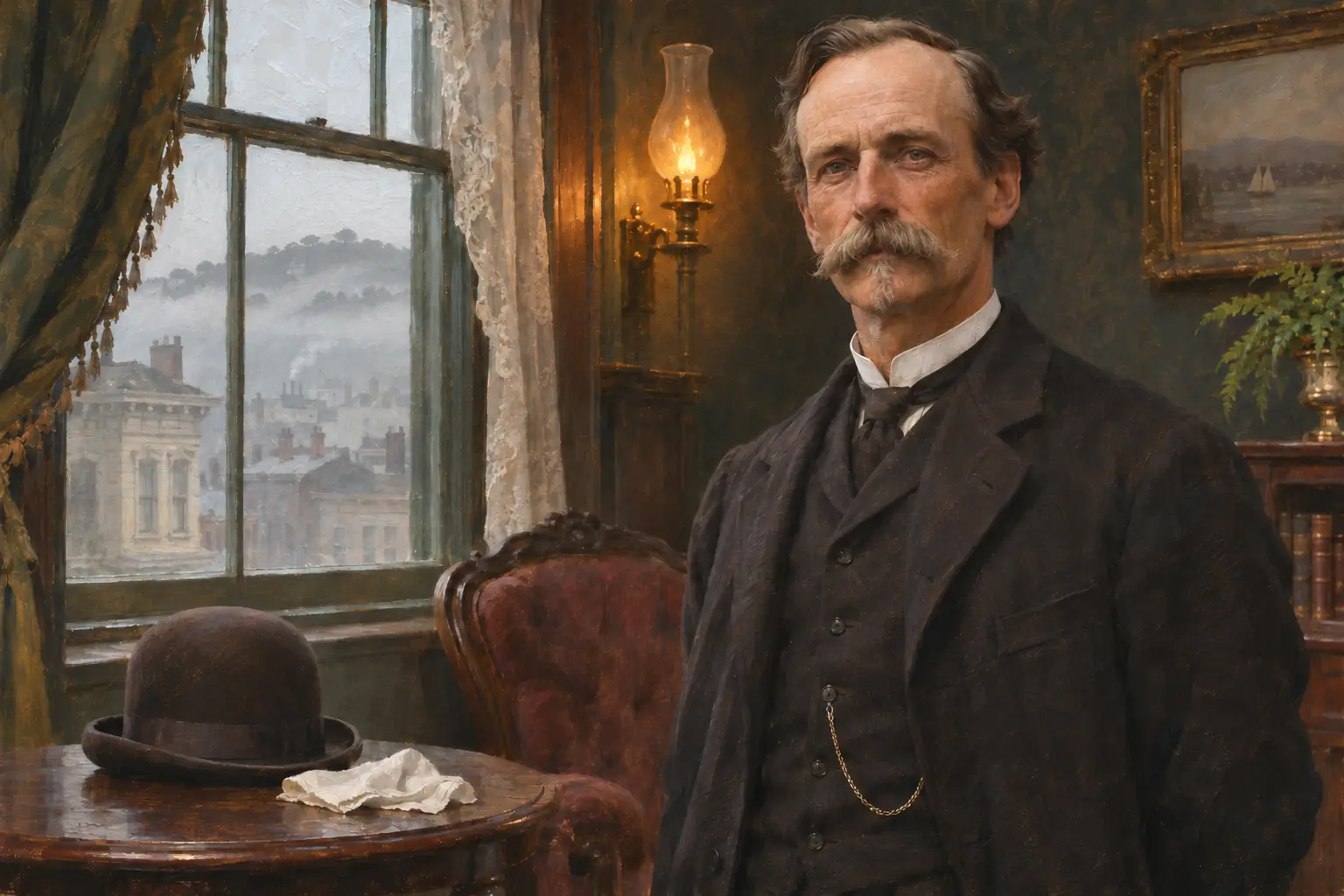
Who was Black Bart? He was Charles E. Boles, a Union Army veteran who robbed Wells Fargo shipments aboard California stagecoaches and left poems at two holdups. Readers knew the signature before they knew the face. The other Black Bart, the Welsh pirate Bartholomew Roberts, had been dead for more than a century by the time Boles took up highway robbery.
In November 1883 a Sacramento paper reported a brisk demand for photographs of Boles. People living along the stage routes finally got a look at the face he’d hidden under a flour sack. Some men around the stock exchange took one look and recognized a fellow they’d figured for a quiet speculator.
Back home they called him Charley
One man who recognized the name had shared a mining cabin with Boles. In a letter printed by the San Antonio Light in January 1884, he recalled an English-born boy who grew up in Jefferson County, New York. Friends called him Charley. Around home he had a reputation as a wrestler, one of the best in the county for his weight by his old friend’s reckoning.
The same man remembered Charley and his brother David turning up at his cabin on California’s American River during the gold rush. They stayed and worked alongside him, with modest returns. On a later trip, David and another brother, Robert, fell ill. Neither made it home.
Boles married Mary Elizabeth Johnson, had children and farmed. In 1862 he enlisted in the 116th Illinois Infantry. He rose to first sergeant and was wounded in Union service. When the war was over, he headed west again. Mary and the children stayed behind. According to the Calaveras Heritage Council, his letters stopped coming and Mary eventually thought he was dead.
How many stagecoaches did Black Bart rob?
Even two accounts that land on twenty-eight robberies start the clock in different years. The Calaveras Heritage Council places his first holdup near Copperopolis in July 1875. California’s prison history starts with a holdup in August 1877. Historian Richard H. Dillon counts twenty-nine between 1875 and 1883. The court record can’t settle the count for us. His guilty plea covered one robbery.
In San Francisco, he went by Charles Bolton. He took rooms at Webb’s Hotel and talked about mining, a subject he actually knew. His neighbors had a ready explanation for his trips out of town. The people who met him on the stage roads remembered something else about his conversation. He could demand somebody else’s money and still say please.
That courtesy helped earn him the name “gentleman bandit.” Passengers generally kept their purses. The driver still had to answer a man holding a shotgun. California’s prison history says Boles later claimed he kept it unloaded because he’d seen enough bloodshed in the war. A driver had no way to know that. How much comfort would you have taken from the word “please” up on that seat?
The passengers on Henry Bacon’s Arizona stage had a different experience. When Pearl Hart and Joe Boot robbed it in 1899, the passengers lost cash and a gold watch. Bacon lost his revolver.
Why did Black Bart leave poems?
In a verse he left in 1877, Boles complained that he’d worked hard for his bread. His reward, as he told it, was to have people tread on his corns. It sounded like a workingman’s grievance right up to the last line, when he called his well-heeled enemies “fine-haired sons of bitches.” His manners on the page could be rather different from the ones he used with the driver.
He signed himself Black Bart. The name already belonged to a highwayman in a California newspaper adventure story by William Henry Rhodes. Boles added a joke of his own, signing as the “Po8.” Say it out loud. In another verse he borrowed the rhythm of a child’s bedtime prayer and ended by picturing the money from the box in his purse. The Calaveras Heritage Council counts just two authenticated poems. That was plenty for the papers to work with.
A New York publisher put Belle Starr on a book cover and crowned her the Bandit Queen after her death. Boles got to pick his own billing. Every paper that printed his verses gave readers the story in the robber’s own words.
The name on the laundry account
On November 3, 1883, Reason McConnell was driving the stage from Sonora to Milton when Boles robbed it near Copperopolis. Shots were fired at Boles. A handkerchief turned up at the scene. Someone in a San Francisco laundry had marked it so the wash would go back to the right customer. That customer was Charles Bolton.
The Sacramento Daily Record-Union carried a dispatch from San Andreas dated November 16. Sheriff Thorn told the court that the prisoner had admitted taking the shipment and told him where to find it. Boles went with the officers, who recovered the stolen property. Yet that same dispatch reported that the prisoner denied being Black Bart and had confessed to no other robbery.
In other words, he owned up to robbing McConnell’s coach. He stopped short of laying claim to everything the papers had pinned on their favorite poet. The name went into San Quentin’s register anyway. The entry reads C. E. Bolton, alias Black Bart.
What became of the gentleman bandit?
Boles drew a six-year sentence. He spent much of his time working in the prison’s drug department and hoped to find work with a druggist when he got out. He earned time off for good behavior and left San Quentin in January 1888, a little over four years after he went in.
The records show he never came back to San Quentin. What he did afterward is harder to settle. Biographer John Boessenecker attributes three more robberies to him after his release. His eventual whereabouts remain uncertain. People kept finding uses for the name Black Bart long after they lost track of Charles Boles.
Think back to those men at the San Francisco stock exchange, studying the new photograph. The face was familiar. They’d seen a well-dressed man going about his business. Reason McConnell could have told them what it was like to spend part of a working day with the same man. He was the one who had to answer when the gentleman asked for the box.
Till next time, put that inner BadAss of yours to good use.

Explore our Old West Outlaws collection.
Sources and Further Reading
- San Antonio Light via the Library of Congress — An old acquaintance remembers Charley, January 15, 1884, page 1, column 4
- Sacramento Daily Record-Union via the Library of Congress — The guilty plea and the demand for photographs, November 17, 1883, page 1, column 6
- Calaveras Heritage Council — Black Bart, including both verses and the account of driver Reason McConnell
- California Department of Corrections and Rehabilitation — Contemporary reporting, the San Quentin register and Boles’s years in prison
- Richard H. Dillon, American National Biography — Black Bart, biographical entry and robbery count (public extract)
- Smithsonian Magazine — The Poetic Tale of Literary Outlaw Black Bart
- Kirkus Reviews — John Boessenecker’s Gentleman Bandit and the robberies he attributes to Boles after prison