
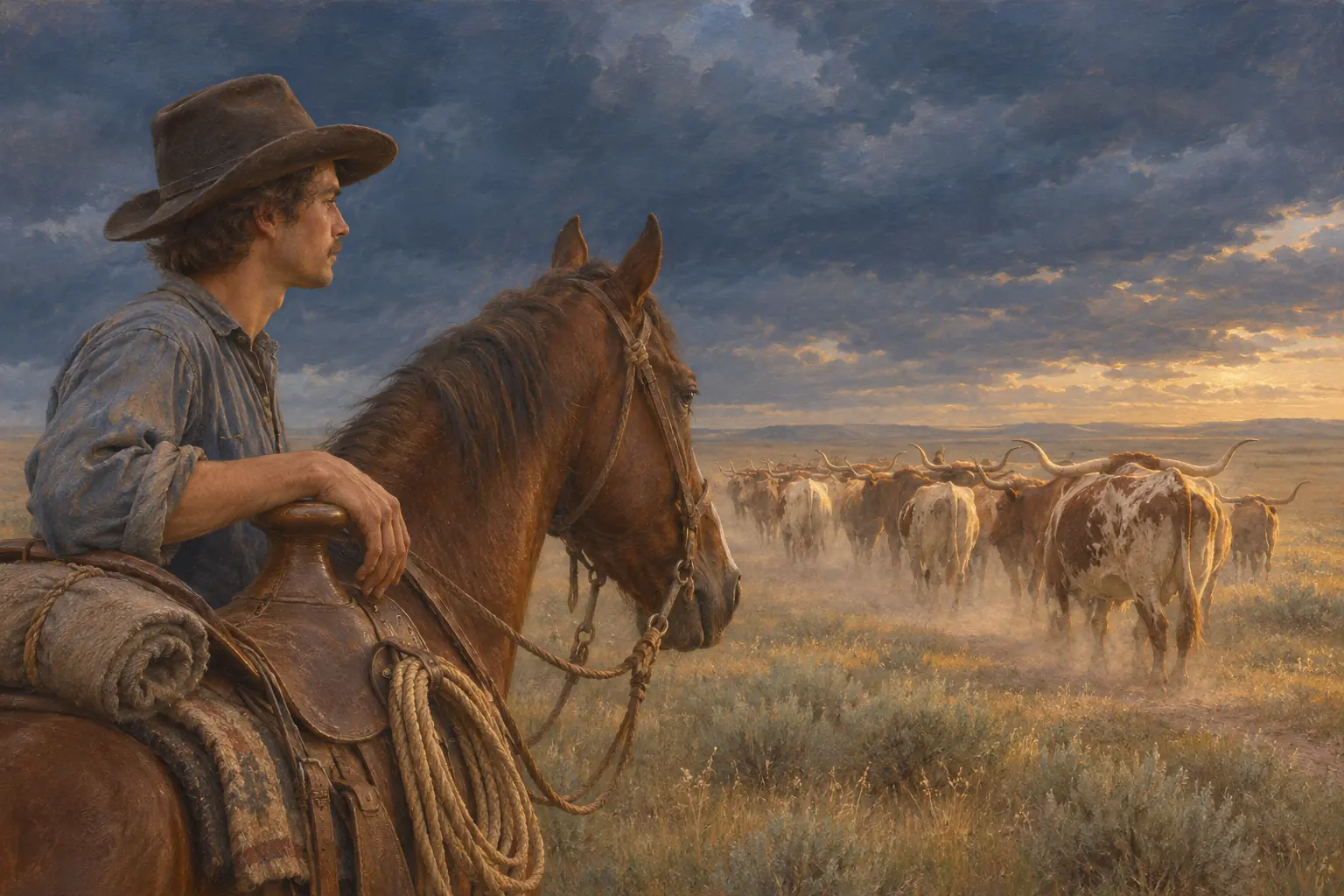
Who was Sam Bass? He was an Indiana farm boy who went to Texas to be a cowboy, made money racing a mare, and wound up robbing trains. Before any of that train money passed through his hands, a sheriff used to hand him cash and send him to Dallas for lumber. Bass was the man he trusted to bring back the supplies and the change.
A few years later, Texas cattle owners trusted Bass and his partner with a herd. This time the men sold the cattle, paid the trail hands and kept going. If you want to know how the sheriff’s young freighter ended up on the wrong side of a manhunt, that’s a good place to look.
The sheriff’s money and the Denton Mare
Bass was born near Mitchell, Indiana, in 1851. Both his parents had died before he turned thirteen. After several years with an uncle and a spell working at a Mississippi sawmill, he reached Denton, Texas, in 1870. He tried ranch work, tended horses at the Lacy House hotel, and hauled freight for Sheriff William Egan.
An account published in Dallas the year Bass died says Egan had one complaint about him. On buying trips, young Sam pinched pennies so hard that he skimped on food for himself and his horses. The sheriff had to tell him to spend a little more.
Horse racing paid better for a while. Bass acquired a fast horse known as the Denton Mare and won races around North Texas before taking her down toward San Antonio. The 1878 writer practically blamed the mare for what became of her owner. She could win him a purse. What he did with the winnings was his business.
Whose money did Bass and Collins lose?
In 1876 Bass and Joel Collins took a herd north for several Texas owners. At Dodge City they heard that cattle fetched a better price farther up the trail. They drove on. According to historian Wayne Gard, the two men had $8,000 left after the sale and the trail crew’s pay. They still owed for the cattle back in Texas.
Gard’s account puts their losses at the gambling tables in Ogallala and Deadwood. Round Rock’s local history also describes a failed try at gold prospecting. Accounts differ about where the cash went. They agree the men who had driven the herd north ended up broke.
Bass and Collins tried hauling freight again. It went badly. Then they took up robbing stagecoaches. Going back to freight work tells us something about the choices they had. Even after the cattle money was gone, Bass could still make use of the skill that once earned him the sheriff’s trust. If you’d been one of the owners waiting in Texas, which choice would you have wanted him to explain?
The people on the Big Springs train
On September 18, 1877, Bass rode with Collins’s gang in the robbery of a Union Pacific passenger train at Big Springs, Nebraska. The express car carried a reported $60,000, much of it in new twenty-dollar gold pieces. The robbers took cash and watches from the passengers as well.
In a report reprinted nine days later in Michigan’s Ingham County Democrat, the conductor, a man named Patterson, actually got his watch back. One of the robbers dropped it, and Patterson picked it up after they left. Andy Riley was less lucky. The same account says a bullet grazed his hand and he lost $25 and two watches.
A passenger’s gold watch also turned up among the goods recovered after Pearl Hart and Joe Boot robbed an Arizona stagecoach in 1899. In both places, the people who lost their watches had a pretty personal stake in the story.
How the Sam Bass gang came apart at Round Rock
Collins died within weeks of the Nebraska robbery. Bass made it back to Texas and put together a new gang. In the spring of 1878 they robbed four trains near Dallas for relatively little money. The Texas Rangers joined the chase, and one of Bass’s own men, Jim Murphy, agreed to help them. Murphy later said he’d been promised help with charges against both him and his father.
On July 19, Bass, Seaborn Barnes and Frank Jackson walked into a general store in Round Rock. They had come to town planning a bank robbery. The shooting started before they could carry out the robbery. Williamson County deputy A. W. Grimes approached them about a pistol. The men opened fire, and Grimes died there. He and his wife Charlotte had three children.
Another deputy, Morris Moore, was wounded. Barnes died in the gunfire, and Jackson helped the badly wounded Bass out of town. Searchers found Bass the next morning. He died in Round Rock on July 21, his twenty-seventh birthday.
Who gets remembered in the Sam Bass ballad?
John Wesley Hardin wrote his own life story. Sam had singers to tell his. Open John Lomax’s 1910 collection of cowboy songs and you’ll meet the mare, the cattle, the gang and Jim Murphy. The singer has a soft spot for Sam and a low opinion of the man who informed on him. When the verse about the Union Pacific turns to the robbers who died, it calls their share “hard-earned money.”
That’s a mighty generous way to describe somebody else’s cash. In 1939, more than sixty years after Bass died, John and Ruby Lomax recorded a man singing about him at a house near Medina, Texas. Long after the robbery, you could still learn Sam’s name just by listening to somebody sing.
Listen to it from Andy Riley’s end of the train. He went in with two watches and twenty-five dollars and came out with a grazed hand. Whose money would he have called hard-earned?
Till next time, put that inner BadAss of yours to good use.

Explore our Old West Outlaws collection.
Sources and Further Reading
- Wayne Gard, Handbook of Texas — Sam Bass’s early work, racing, the cattle sale and the two gangs
- University of North Texas Libraries — Life and Adventures of Sam Bass, the 1878 Dallas account. See chapters I–II for Sheriff Egan and the mare, and XVIII for Murphy’s account of his bargain
- Nebraska State Historical Society — The Big Springs robbery and the money and watches taken from passengers
- Ingham County Democrat, September 27, 1877 — “The Train Robbers,” page 2. A reprinted Chicago Tribune dispatch names conductor Patterson and Andy Riley (PDF)
- City of Round Rock, Historic Round Rock Collection — The cattle venture, Jim Murphy and the July 1878 shooting at the general store
- Round Rock Cemetery — Deputy A. W. Grimes, his wife Charlotte and their family
- John A. Lomax, Library of Congress — “Sam Bass” in Cowboy Songs and Other Frontier Ballads, 1910, beginning on page 149
- John and Ruby Lomax, American Folklife Center — Listen to E. A. Briggs sing “Sam Bass” near Medina, Texas, May 5, 1939