
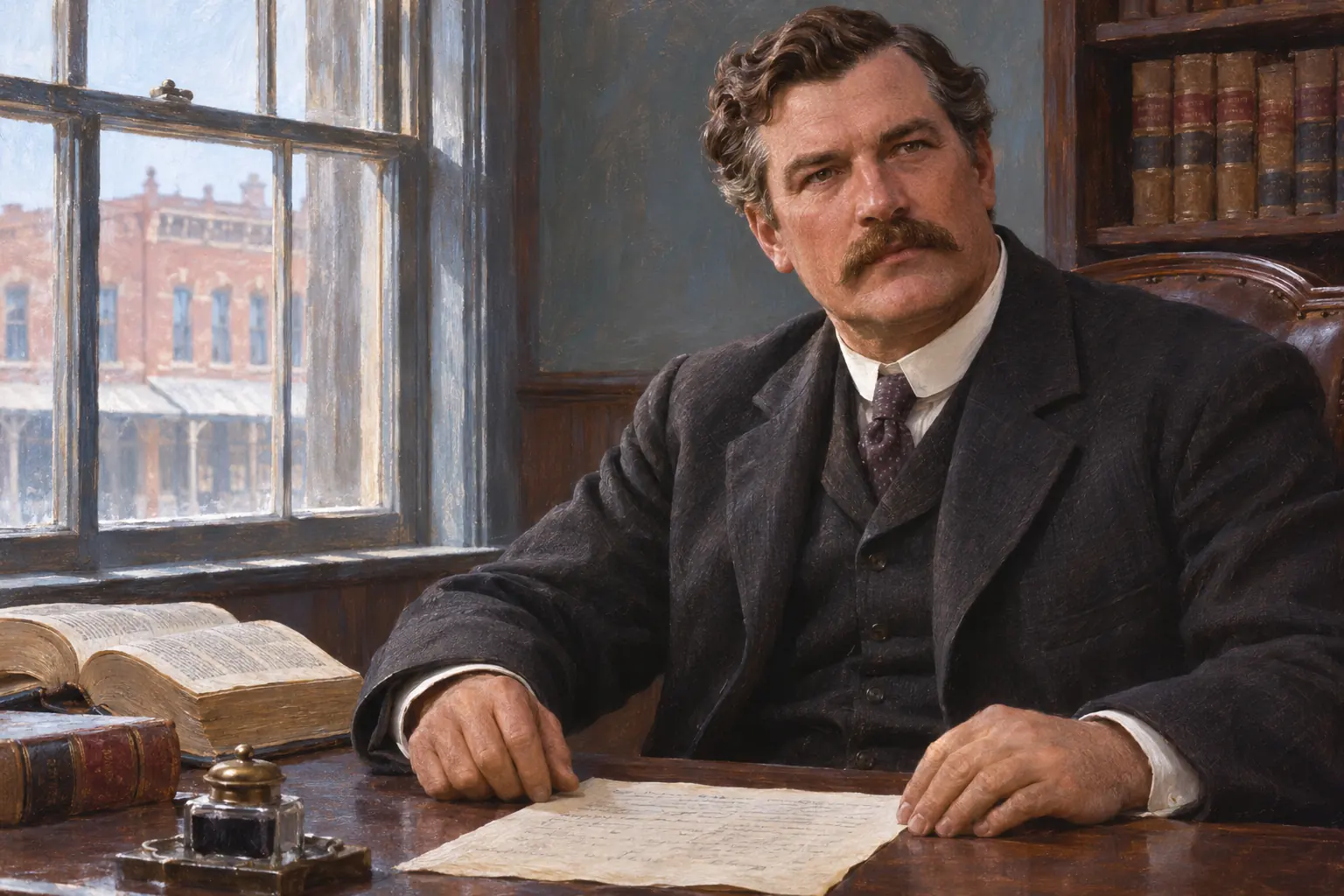
Who was John Wesley Hardin? He was a Texas preacher’s son who killed a man at fifteen, spent more than fifteen years in prison for murdering a deputy, and later became a lawyer. By the time he opened his El Paso office, he’d had years of practice arguing one particular case. He wanted people to believe he’d had good reason to kill.
Consider a small point on which Hardin and a reporter covering his murder trial agreed. When Hardin asked Deputy Charles Webb what he was holding, Webb showed him a cigar. What the deputy tried to do next depends on which account you read.
The boy who ran after killing Mage
Hardin was born in Bonham, Texas, in 1853. His father was a Methodist circuit preacher who also taught school and practiced law. Hardin grew up hearing the Confederate cause praised at home. As a boy, he saw people set fire to figures made to look like Abraham Lincoln. He remembered those lessons decades later, when he sat down to explain the first life he took.
In the fall of 1868, Hardin and a cousin wrestled a formerly enslaved Black man near Moscow, Texas. Hardin called him Mage. By Hardin’s account, the boys threw Mage down twice and scratched his face hard enough to draw blood. When the two met again the next day, Hardin was on horseback. He said Mage came after him with a stick. Hardin shot him, then went to his family.
Hardin wrote that his father advised him to hide. He claimed a white Southerner who killed a Black man had no chance of a fair trial. Two years before Mage died, Texas lawmakers had restricted when a Black witness could testify in a criminal case. During Reconstruction, federal Freedmen’s Bureau agents pressed local courts to give Black Texans the same rights white Texans already had.
Hardin went into hiding before any court could hear his defense. He also claimed he killed three federal soldiers sent to arrest him. Historian Leon Metz identifies that episode as Hardin’s own claim. We know what Hardin thought of the wrestling match because he lived to write about it. Mage never got to tell readers what it felt like to have two boys throw him down and draw blood.
What did Charles Webb try to do?
By 1874, Hardin had driven cattle to Kansas, married Jane Bowen, and sided with relatives in the Sutton-Taylor feud in Texas. On May 26, his twenty-first birthday, he met Charles Webb outside a saloon in Comanche. Webb was a deputy from neighboring Brown County. He told Hardin he had no papers for his arrest.
In Hardin’s telling, the two men had settled things. Hardin offered Webb a drink or a cigar. As he turned to go inside, his friend Bud Dixon called out a warning. Hardin said he saw Webb reaching for a gun and fired to save his own life.
A Galveston newspaper correspondent who covered the trial reported testimony about someone else calling out. Judge Thurmond, standing in the street, called Webb over to him. According to that account, Webb started toward the judge. Hardin stopped him. It makes a difference whether Webb was going for a gun or going to join a man who knew him as Charlie. Webb died outside the saloon.
A Florida bill and a Texas verdict
Hardin fled. In Comanche, a mob took his brother Joe and two cousins from jail and lynched them. Jane and the couple’s young daughter followed Hardin east. He used the name J. H. Swain in Florida. The guide to his papers at Texas State University lists an ordinary piece of evidence from that time, a Jacksonville merchant’s bill made out to Swain in 1875.
In 1877, Texas Rangers and local officers caught up with Hardin in Pensacola. That September a Comanche County jury convicted him of second-degree murder in Webb’s death and set his sentence at twenty-five years. The Texas Court of Appeals upheld the verdict in 1878. You can read its decision and know exactly which death sent Hardin to prison. The long lists of killings credited to him offer nothing like that certainty.
The case where Hardin pleaded guilty
At Huntsville, Hardin tried to escape more than once. In time he ran the prison Sunday school and began studying law. A Huntsville lawyer sent him a reading list that included contracts and evidence. By then Jane was raising their three children. By 1889 Hardin was explaining Webb’s death in a letter to his young daughter. His family heard his defense long before book buyers did.
While he was still in prison, Hardin faced another charge, this one over the 1873 killing of James Morgan in Cuero. His lawyer wanted him to argue that the killing was justified. In 1892 Hardin chose to plead guilty to manslaughter. The two-year sentence ran alongside the time he was already serving.
If you’d been asked to support a pardon for Hardin, how much weight would you have given that plea? He took responsibility for Morgan’s death in open court. He also settled an old charge that could have put him right back behind bars.
John Wesley Hardin, attorney at law
Jane died in 1892. After more than fifteen years at Huntsville, Hardin walked out in February 1894. Governor James Hogg pardoned him in March. In July a panel of Gonzales County lawyers examined him, and he earned his license. He had clients, too. That October, Ramon and Luis Aguero signed notes promising him their family wagon, two mares and harnesses for his legal work.
In 1895 he opened an office on the second floor of the Wells Fargo Building in El Paso. His business cards advertised his law practice. On August 19 of that year, Constable John Selman shot and killed him at the Acme Saloon. Hardin was forty-two. Among the things he left behind were his law books and an unfinished account of his life.
Who got the last word?
Cowboy singers helped decide how people remembered Sam Bass. Hardin put his own name to the story. His children won the rights to his manuscript, and a Texas publisher brought out his autobiography in 1896. Its preface assured buyers that Hardin had never killed anyone in cold blood. That was quite a character reference to tuck into the front of his own book. Tiburcio Vásquez got his account to readers sooner. He gave a newspaper interview about what drove him to robbery while he was still waiting for his trial.
Read Hardin for what he remembers, right down to the cigar in Webb’s hand. And leave room for the detail the trial reporter heard, the one missing from Hardin’s book. Somebody called Charlie’s name, and for a moment the deputy had somewhere else to go.
Till next time, put that inner BadAss of yours to good use.

Explore our Old West Outlaws collection.
Sources and Further Reading
- John Wesley Hardin, Library of Congress — The Life of John Wesley Hardin, 1896. Read the publishers’ preface, pages 11–14 on Mage, and pages 91–93 on Charles Webb
- W. A. F., Galveston correspondent — October 2, 1877 report from Comanche on the testimony at Hardin’s trial, reprinted by Brownwood News
- Texas Court of Appeals — Hardin v. State, 4 Tex. Ct. App. 355 (1878). The verdict, sentence and ruling on appeal
- Leon C. Metz, Handbook of Texas — John Wesley Hardin’s childhood, early violence and account of the soldiers
- University of North Texas, Texas History for Teachers — Excerpts from the Texas Black Codes of 1866, including restrictions on witness testimony (PDF)
- Cecil Harper Jr., Handbook of Texas — The Freedmen’s Bureau in Texas and its work on equal treatment in court
- The Wittliff Collections, Texas State University — Guide to the John Wesley Hardin Papers, including the Swain bill and descriptions of letters to Jane and the children (PDF)
- John G. Browning, Journal of the Texas Supreme Court Historical Society — From Outlaw to Attorney at Law. Hardin’s prison studies, Morgan plea, clients and law practice (Winter 2018, PDF)